
Craft
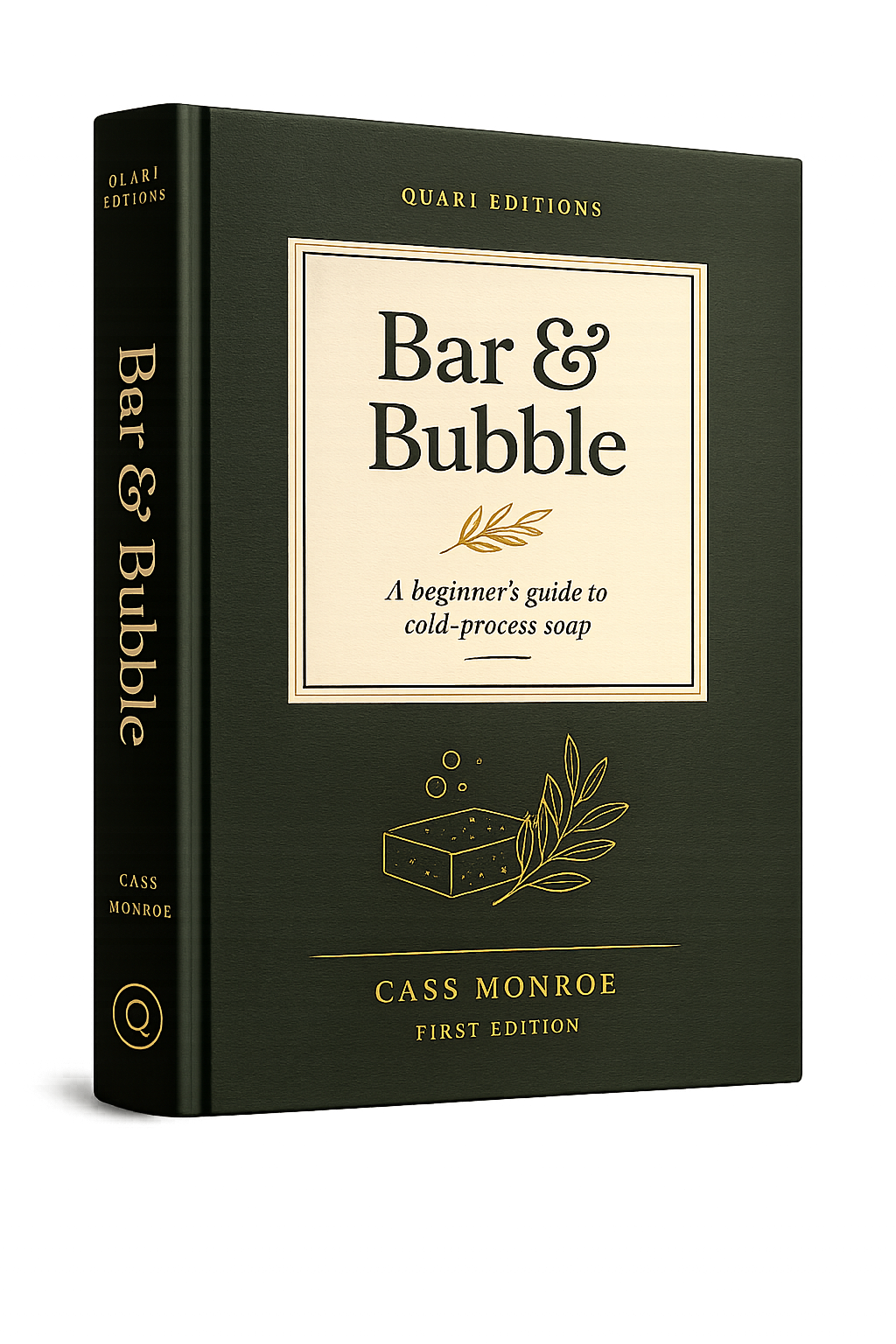
Bar & Bubble
A beginner's guide to cold-process soap
Cass Monroe · Quari Editions · First Edition
Soap looks complicated because the internet has made it complicated. The truth is that people made soap at home for centuries before there were YouTube tutorials, Reddit threads, or sixteen competing opinions on water discount. Bar & Bubble takes the whole thing back to the beginning: what lye actually does, why oils matter, how to scent something without it smelling like a candle store had an accident, and how to make your first bar without burning yourself or wasting a batch. Clear, practical, slightly opinionated — the book you'd want if you wanted someone to just tell you how it works.
Sample reading
Introduction
Soap is a chemical reaction with a long history and a surprisingly low barrier to entry. You combine an oil with an alkali — lye, specifically — and through a process called saponification, both substances transform into something that is neither. The oil is not the soap. The lye is not the soap. The soap is what they become together.
I'm starting here, with the chemistry, because most soap-making books start with the romance — the botanicals, the essential oils, the beautiful marbled loaves — and leave the chemistry for a middle chapter that everyone skips. That's backwards. The chemistry is why it works. The botanicals are just how it looks.
I don't expect you to love the chemistry. I just want you to understand the shape of it, because once you do, a lot of the fear goes away. The fear of lye is real and worth respecting — it's caustic; it will burn; you should wear gloves and goggles and not make soap while distracted. But the fear that soap-making is some arcane art only accessible to the initiated is not real, and this book is designed to dissolve it.
By the end of chapter four, you will have made a bar of soap. It will be simple. It will probably be slightly imperfect. It will work. That's the goal of a first batch: a working, finished bar that proves to you that you can do this. Everything after that is refinement — better oils, more interesting scents, techniques that make your soap look the way you want it to look. But refinement requires a foundation, and the foundation is one finished bar.
Here's what I won't do: tell you there's only one right way. There are at least four strongly held opinions on water discount, three schools of thought on superfat percentages, and an ongoing debate about stick blending versus hand stirring that I have watched consume entire online communities. I'll give you my approach, tell you why I like it, and let you argue with me later, once you've made enough soap to have opinions of your own. That's the only way this craft works.
Let's start with what soap is.
III. Lye Safety, Simplified
Lye has a reputation problem. Type "soap making" into any online forum and within three replies someone will have mentioned chemical burns, or the need for a hazmat suit, or their cousin's friend who made soap once and — and then the story escalates in ways that are not particularly useful to someone who just wants to make a bar of lavender soap on a Sunday afternoon.
Here is the accurate version: lye is sodium hydroxide. It is a strong alkali. When it contacts moisture, including the moisture in your skin, it generates heat and can cause chemical burns. It is not, however, uniquely terrifying. It is available at hardware stores. It is used to cure olives and make pretzels. It has been used in soap-making in every culture that has made soap, which is most of them, for most of recorded history, by people who did not have PPE.
What it requires is respect and attention, not fear and avoidance.
The three rules of lye safety
First: always add lye to liquid, not liquid to lye. This one is non-negotiable and the reason is straightforward: when lye hits liquid, it generates heat rapidly. If you add too much liquid at once, you can get splashing. If you add liquid to lye, you get vigorous volcanic splashing. Add lye to liquid, always, slowly, stirring as you go.
Second: wear gloves and eye protection. Not goggles rated for a chemistry laboratory — the safety glasses you use for home improvement will do fine, and nitrile gloves work perfectly well. The goal is to keep lye off your skin and out of your eyes. Splashes happen to everyone; protection means they're inconveniences rather than injuries.
Third: work in a ventilated space. When lye hits liquid, it releases fumes briefly. They're not dangerous in small quantities in a ventilated room, but they're not pleasant either. Open a window. Don't lean over the bowl. Step back while it's mixing.
That's the whole list. If you follow these three rules, the risk of soap-making is roughly equivalent to the risk of deep-frying, which is to say: real, manageable, and not a reason to avoid it.
What to have ready before you touch the lye
Before you measure your lye, everything else should be prepared. Your oils should be in the pot. Your mold should be lined and ready. Your protective gear should be on. Your liquid — water, milk, or whatever you're using — should be measured and sitting in a heat-safe pitcher or bowl, in the sink or on a towel, not near the edge of anything.
The reason for this is simply that once the lye hits the liquid, the temperature will spike to somewhere between 180 and 200 degrees Fahrenheit and you will want to let it cool before using it. While it cools, you don't need to do anything except wait. Having everything else done before you start means you're not scrambling around with your gloves on, trying to find the spatula, while a hot caustic solution sits waiting.
One more thing: don't make soap unsupervised when you're tired or distracted. Lye doesn't care that you've had a hard week. The care-and-attention requirement is consistent.
What to do if something goes wrong
Lye on skin: rinse with cool running water for at least fifteen minutes. Don't use vinegar or other acids to neutralize it — this generates heat and makes things worse. Cool water, running, fifteen minutes minimum.
Lye in eyes: rinse with cool running water for at least fifteen minutes and then seek medical attention. This is the one scenario that escalates beyond what you can handle at home.
Lye spill on a surface: rinse with plenty of water. It's water-soluble. Your countertop is fine; check for etching on natural stone surfaces.
These are real contingencies, and I mention them not to frighten you but because knowing what to do if something goes wrong is part of doing something safely. Most people who make soap for years never have more than a small skin splash. Being prepared doesn't mean expecting disaster — it means you can handle it calmly if it happens, and then go back to making soap.
— End of sample —
This volume was published with Quari — brief to bound book to storefront, in an afternoon.