
MANGA
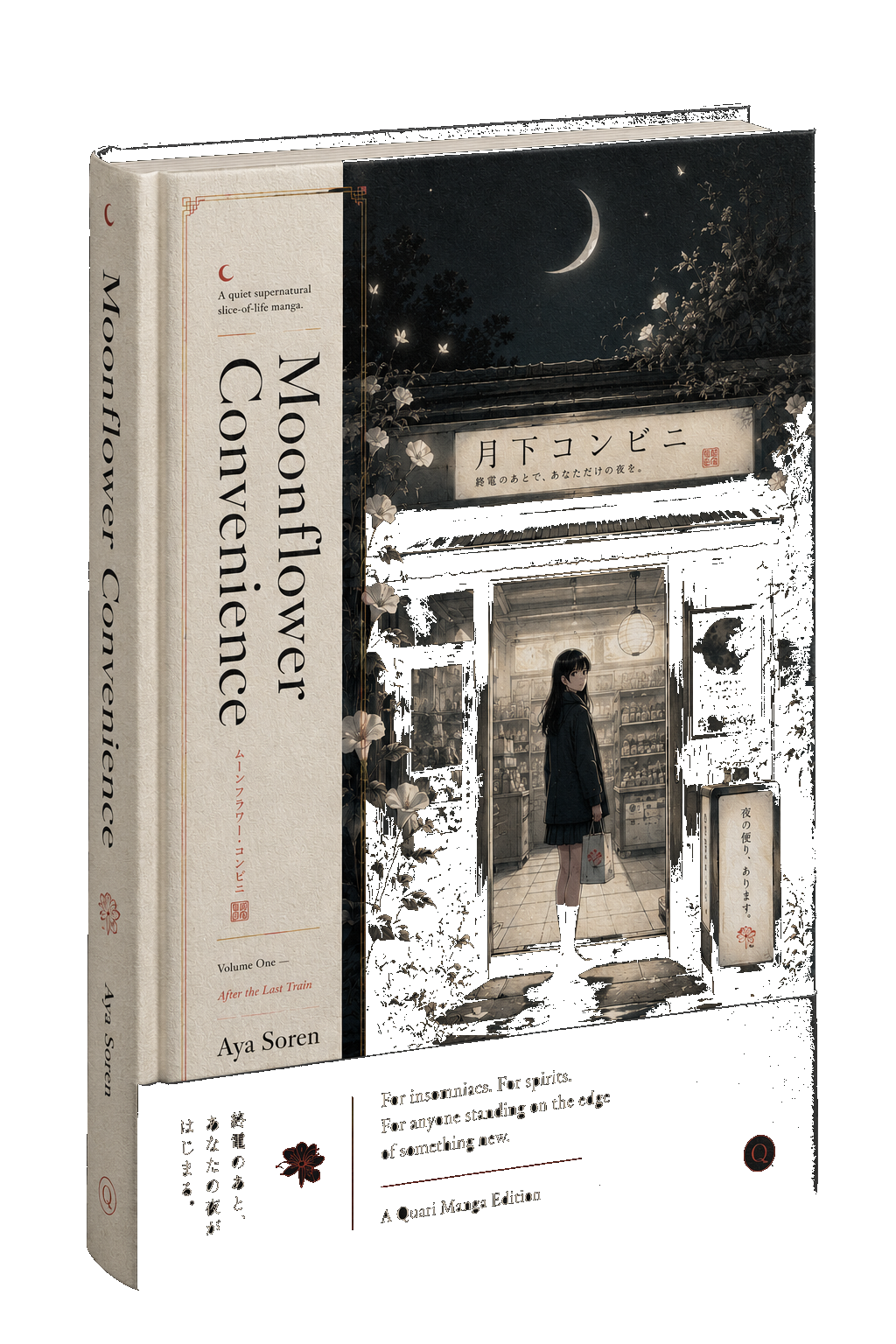
Moonflower Convenience
A quiet supernatural slice-of-life manga · Volume One: After the Last Train
Aya Soren · Quari Editions · First Edition
Softcover / Collector Edition · 224 pages · Grayscale Art · Right-to-Left Reading
After finding a hidden convenience store that appears only once the last train has left, a teenage girl begins taking midnight shifts for customers who are not always living, and not always lost. Moonflower Convenience is a quiet supernatural slice-of-life manga about second chances, unspoken goodbyes, and the small mercies we hand each other in the dark. Each night offers a quiet exchange, a second chance, or a message someone forgot to carry home.
Sample reading
Introduction
There is a convenience store on the edge of the last train line that does not appear on any map, does not show up in daylight photographs, and does not sell anything you would think to buy before midnight. The sign above the door reads 月下コンビニ — Moonflower Convenience — and the hours posted in the window are simple: open when the last train leaves, closed when goodnight is finally said.
This is not a story about saving the world. It is a story about the small transactions that happen in the dark — a forgotten message carried home, a second chance handed across a counter, a goodbye that finally finds its recipient three years late. If you have ever missed the last train and walked home through streets that felt briefly like someone else's life, you already know the neighborhood.
Chapter 1. The Last Train Leaves
Hina missed the last train because she was sitting on the platform bench reading a text she did not answer.
It was from her mother — a short message, the kind that pretends to be casual while asking something enormous. Are you coming home this weekend? Three words that meant: I am still here. I am still waiting. I do not know how to say any of that directly.
The train doors closed. The platform emptied. The station lights hummed their late-night frequency — that particular fluorescent tiredness that makes everything look slightly unreal.
Hina stood, tucked her phone away without replying, and walked toward the stairs.
At the bottom of the exit ramp, where the street should have been, there was a shop.
It had not been there that morning. She was certain of this. She walked this route every day. But there it was — a small convenience store with warm light in the windows and a red awning and a pot of moonflowers climbing the wall beside the door, white blooms open in the dark as if they had been waiting for exactly this hour.
The sign above the door read 月下コンビニ.
Hina stood on the sidewalk and looked at it for a long time.
Then she went inside.
— End of sample —
This volume was published with Quari — brief to bound book to storefront, in an afternoon.