
Parenting
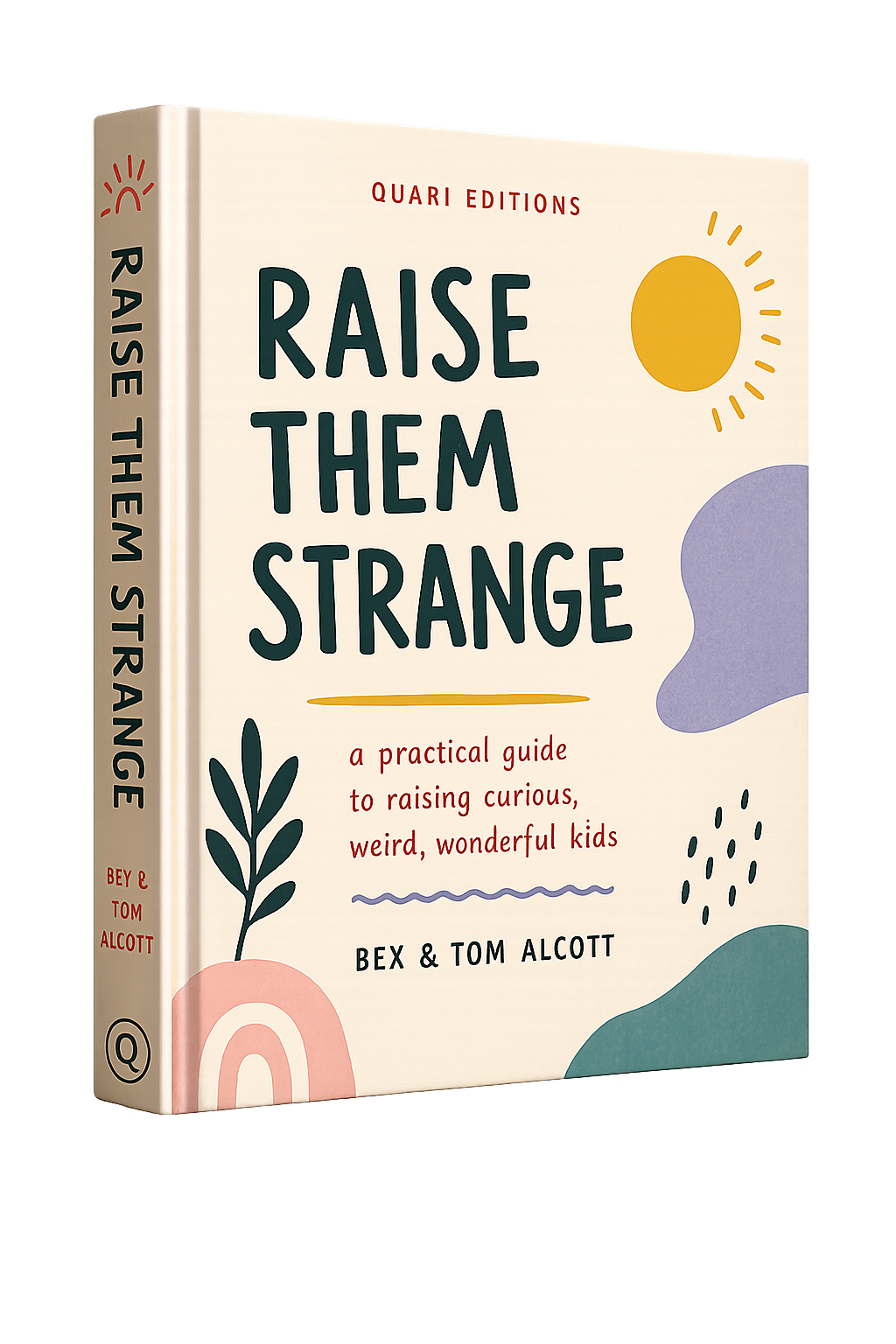
Raise Them Strange
A practical guide to raising curious, weird, wonderful kids
Bex & Tom Alcott · Quari Editions · First Edition
The parenting books tell you how to raise well-adjusted children. This one tells you how to raise interesting ones — which, in our experience, requires a different set of instructions. Raise Them Strange is for parents who want to encourage a kid's particular weirdness rather than sand it off, who believe that boredom is underrated and structured play is overrated, and who have noticed that the most compelling adults they know are people who were allowed, as children, to be genuinely strange. Funny, honest, and occasionally contradictory — because parenting mostly is.
Sample reading
Introduction
Our son spent eight months convinced that parking lots had interesting geological histories. Not interesting in the way children usually mean — not dinosaurs-interesting or volcanoes-interesting — but genuinely interested in the substrate, in what was under the asphalt, in why this particular piece of earth had been chosen to hold cars rather than something else. He would ask us, in parking lots, to explain land use history. He was six.
We had no idea how to explain land use history.
What we learned, across eight months of parking lot questions, is that we weren't supposed to have the answers. We were supposed to have the willingness to not know, the comfort with "I have no idea, let's find out," and the patience to sit with questions that don't resolve quickly, or sometimes at all. That's a different skill from the one most parenting books teach, which is how to have the answers — the right response, the appropriate consequence, the correct approach to sleep regression or screen time or the whole exhausting taxonomy of Things That Must Be Handled Correctly.
This book is not about handling things correctly. This book is about handling them honestly, which sometimes means admitting you don't know, allowing your child to be wrong about something until they figure out they're wrong, and occasionally getting interested in parking lot geology because your six-year-old started a fire and you might as well.
We wrote this together, which means it occasionally contradicts itself. Bex thinks structured activities have more value than Tom does; Tom is more comfortable with screen time in ways that Bex is still arriving at; we have genuine disagreements about how much truth children can handle at various ages, which we have not fully resolved. We left these contradictions in because we think they're more honest than presenting a unified theory of parenting that neither of us fully believes. Parenting is mostly improvised. A book that pretends otherwise is selling you something.
What we've tried to offer instead: the things we've actually found useful, the mistakes that were instructive enough to repeat, and the particular case for raising children who are weird on purpose — not to be difficult, but because weird, in the fullest sense, means having a genuine inner life. It means caring about things for reasons that are your own. It means, when someone asks what you're interested in, having an actual answer.
That's the strange we're raising toward. Not strange as outsider, not strange as difficulty. Strange as alive.
I. On Boredom
The most useful thing we ever did for our kids was get bad at entertaining them.
This was not a parenting strategy. This was exhaustion. Our daughter was four and our son was one, and we were in the phase of parenting where survival is the ceiling and everything above survival feels ambitious. We stopped organizing activities. We stopped cueing up content the moment attention wavered. We stopped, basically, performing the role of recreation director for our own household, because we were too tired to perform it well and increasingly suspicious that we'd been performing it unnecessarily.
What happened when we stopped is what always happens when children have unstructured time: they were bored. Loudly, complainingly, why-is-there-nothing-to-do bored. Bored in the particular way of children who have been accustomed to input and are now experiencing its absence as a minor catastrophe.
We held our ground. Not out of wisdom — out of the aforementioned exhaustion — but the outcome was the same.
Within about forty minutes, our daughter had invented a game that involved all of her stuffed animals having jobs, with a particularly complex economy governing who owed what to whom after a series of disputes we were not allowed to intervene in. This game ran, with significant modifications, for approximately three years. It spawned a narrative universe, several handmade documents with rules and personnel rosters, and one memorable evening in which the bears held a trial that lasted two hours. We understood about a third of what was happening.
We did not make her do this. We just stopped preventing her from being bored long enough for her to get there herself.
Boredom, we have come to believe, is where the interesting stuff starts. Not productive boredom, not scheduled unstructured time, not the kind of boredom you manufacture by setting a timer and announcing that screen time is over. Actual boredom — the uncomfortable kind, the kind where nothing is offered and nothing is suggested and the child has to metabolize the absence and produce something from it.
This is not easy to watch. It's especially not easy to watch if you're someone who reflexively fills silences, which most parents of young children become because young children in discomfort make a distinctive sound and the sound makes you want to fix the discomfort. The boredom-to-invention sequence passes through a genuinely unpleasant middle section, and the whole thing requires you to believe, on not very much evidence, that something good is coming.
The evidence exists, though, if you look for it. The research on unstructured play is pretty consistent: children who spend time in self-directed, unguided play develop more robust problem-solving, more creative approaches to obstacles, and more comfort with ambiguity than children whose free time is primarily structured. More plainly: they get better at making something from nothing, which turns out to be a useful skill for the rest of your life.
We are not advocates for deprivation. Our kids have activities they love and screens they use and parents who engage with them enthusiastically on most of the topics they bring. We're not building character through hardship. We're just sometimes refusing to be the answer to a question they haven't fully asked yet, because the process of asking it — of sitting with not knowing what you want, deciding that you want something, figuring out what that is — is itself the work.
Our son, eventually, moved past parking lots. He became briefly consumed by the history of unit measurement, then by a specific subset of bridge engineering, then by a question about whether fish have preferences that we genuinely could not answer and had to research together for three evenings before arriving at something like an answer. He is now ten and interested in, among other things, the geological history of parking lots again, but with more vocabulary.
We didn't give him any of those interests. We just didn't fill the space where they were waiting.
— End of sample —
This volume was published with Quari — brief to bound book to storefront, in an afternoon.