
BUSINESS
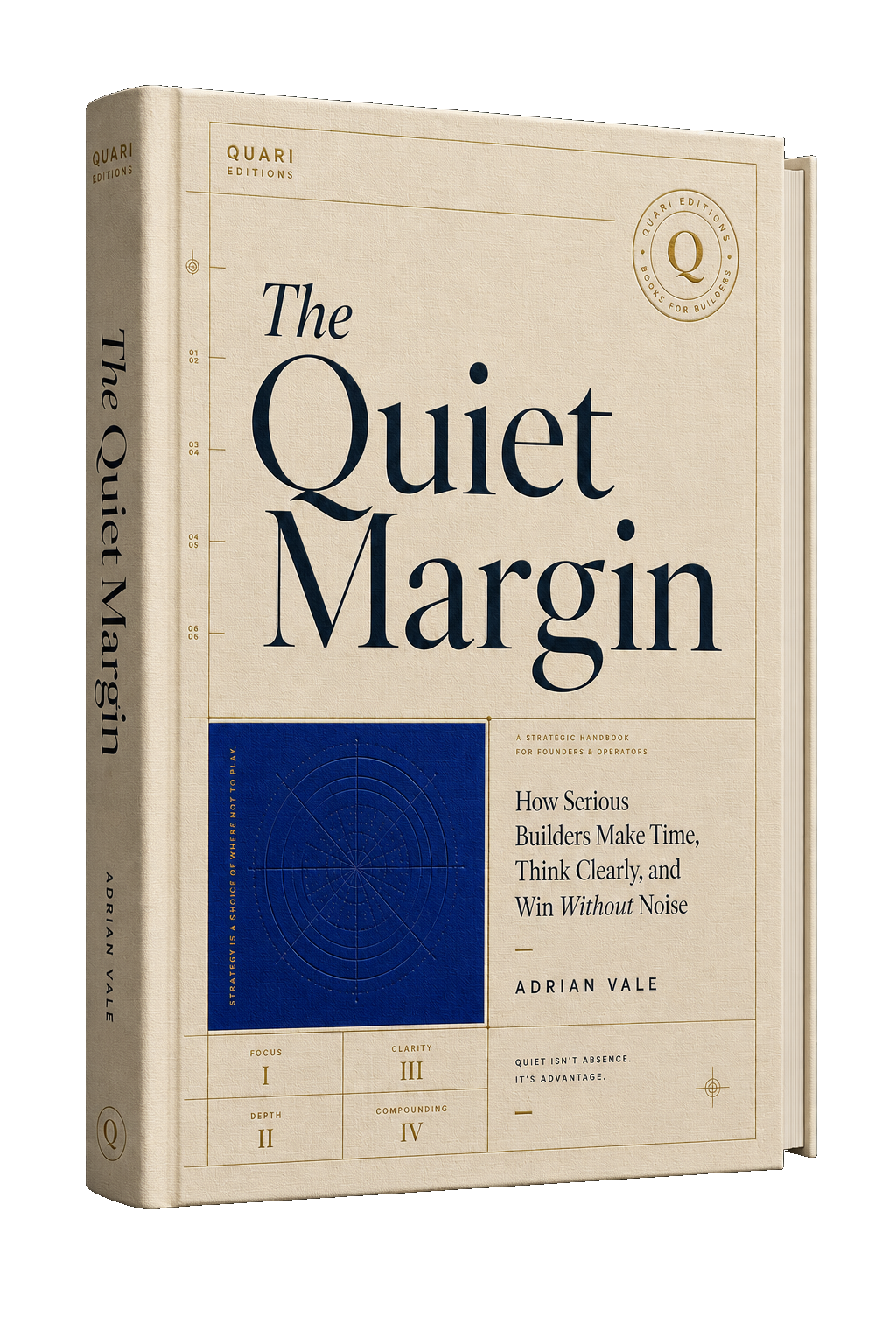
The Quiet Margin
A strategic handbook for founders and operators
Adrian Vale · Quari Editions · First Edition
Time is finite. Attention is your most compounded asset — and most builders spend it like it's free. The Quiet Margin is an operating system for protecting both: how serious builders make time, think clearly, and win without noise. No hustle theater, no productivity cult — just the few decisions that compound, and the discipline to defend the room where real thinking happens.
Sample reading
Introduction
Most business books are written by people who have never had to choose between two good options with forty-five minutes and a full inbox. This one is not. The Quiet Margin is an operating system for a specific problem: you have more opportunities than time, more inputs than clarity, and more noise than anyone should reasonably tolerate.
The margin is not laziness. It is the deliberate space between what you could do and what you will do — the room where thinking happens before action commits you. Every builder I know who has done something worth doing protected that room. Every builder I know who burned out gave it away, one meeting at a time.
This handbook is short on purpose. You do not need more information. You need fewer decisions, made better, defended longer.
I. Focus — Choose a Few Things Worth Doing
The first mistake is not choosing wrong. It is choosing too many things that are individually reasonable.
Every opportunity has a case. Every meeting has a sponsor. Every feature request has a user story and a screenshot and someone on the team who already started building it in a branch you'll discover on Thursday. The problem is not that any of these are bad. The problem is that together they consume the one resource you cannot manufacture: attention that compounds.
Focus is not a personality trait. It is a refusal — repeated daily, without drama — to do the second most important thing before the first one is finished. Most founders I work with can name their top priority in under ten seconds. Almost none of them spent yesterday working on it.
The exercise is simple and uncomfortable: write down everything you did last week. Circle the three activities that moved the business forward. Everything else is margin you gave away. The goal is not zero waste — that is a fantasy for people who do not run companies. The goal is to stop treating your calendar like a public good.
Choose a few things worth doing. Then protect the time to do them. That is the whole first chapter, and most people will need to read it twice.
— End of sample —
This volume was published with Quari — brief to bound book to storefront, in an afternoon.