
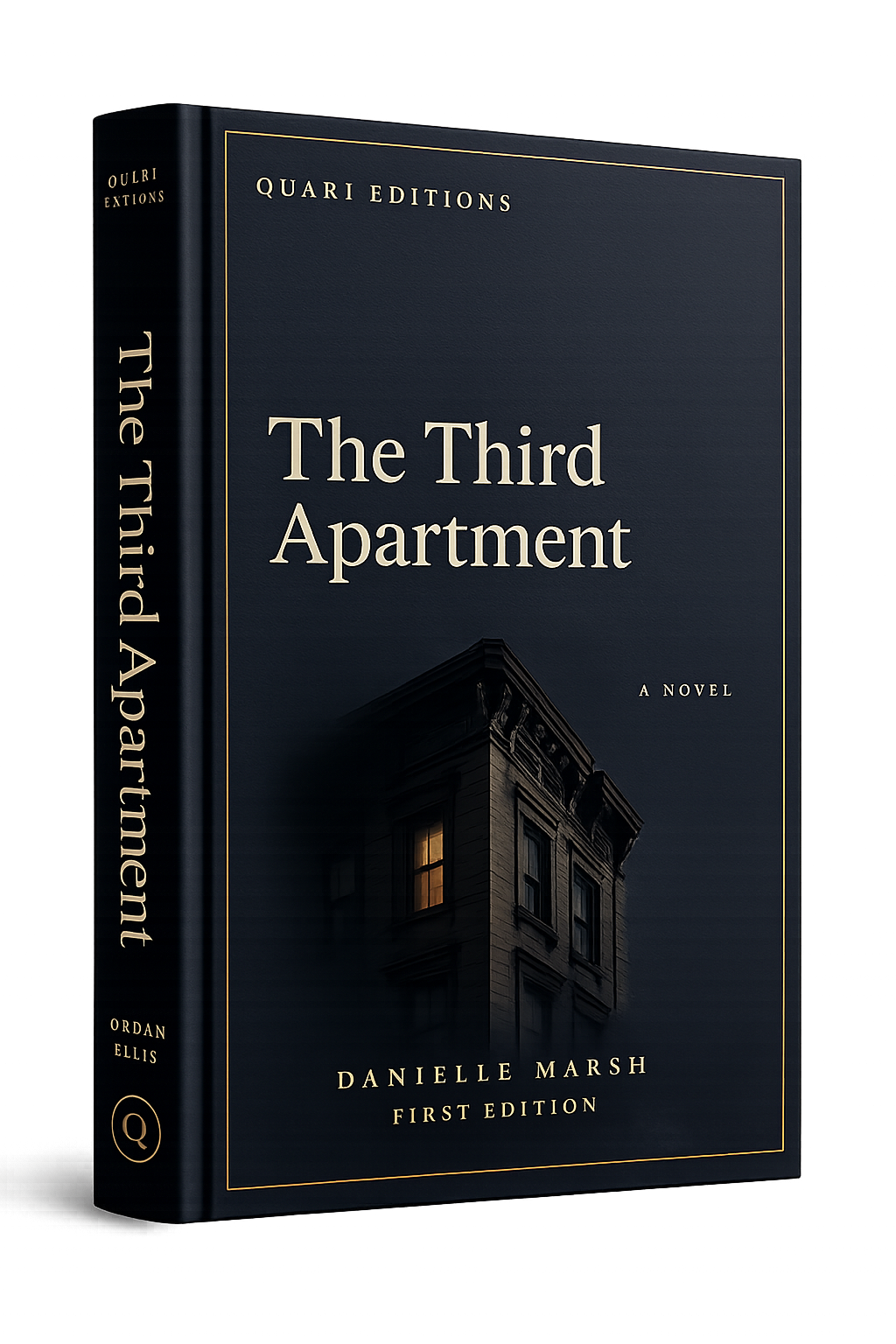
Fiction
The Third Apartment
A novel
Danielle Marsh · Quari Editions · First Edition
When Nora moves into the third apartment she's rented in four years, she tells herself it's the last time. The lease is twelve months. The ceilings are high. The previous tenant left a plant she doesn't know how to kill. But when she finds a journal tucked behind the radiator — entries that end without explanation on an ordinary Tuesday — she starts pulling at a thread she can't put down. The Third Apartment is a quiet thriller about the lives we inherit from strangers, the exits we don't explain, and the woman who can't stop trying to understand both.
Sample reading
Introduction
Every apartment holds what the last tenant left behind. Not just the scratches on the floors, the painted-over hooks, the particular smell of someone else's ten thousand dinners. Something more like a residue of intention — all the plans they made in those rooms that either came true or didn't, all the versions of themselves they tried on and abandoned, all the mornings they woke up in that bed and decided, again, to stay.
I've moved eight times. I know this about apartments the way you know things you didn't choose to learn. Each one taught me something I couldn't have learned anywhere else, by living in the shape someone else had made and slowly, stubbornly, making it into something that felt like mine.
The third apartment is always the significant one. The first is shock. The second is overcorrection. The third is where you stop flinching and start paying attention.
Nora is not me — she's braver in some ways, worse at plants, more methodical in her grief. But she moves into the third apartment the way I always have: with a feeling that this is the one that will finally take, combined with an equal feeling that she's tempting something by thinking so. She finds the journal on her third night, after the movers have gone and the wine is open and the silence has settled into the particular quality of silence that belongs only to new places. She almost puts it in the recycling. She almost does several things in this book that would have made it a much shorter story.
She doesn't, though. And what follows is what this book is really about: not the mystery of who Clara was, but the mystery of why it matters so much to a woman who never knew her, and what Nora is really looking for in someone else's unfinished story.
III. What She Found Behind the Radiator
The radiator made a sound like someone clearing their throat at three in the morning. That was how Nora found out it existed at all.
She hadn't slept well in the apartment yet. Three weeks in, she still woke with the disorientation of the recently relocated — that half-second of not knowing where you are, which is really not knowing who you are, which passes quickly enough but leaves a residue. She'd been lying there waiting for it to pass when the radiator spoke: a slow metal groan followed by a descending series of clanks, like a small, tired machinery making its case for retirement.
She turned on the light. The radiator was in the corner she'd mentally designated as the reading corner, though she hadn't yet furnished it as such — just a lamp on the floor and an ambition. The paint on the radiator's joints was cracked and old, layered in years of white over cream over white again. Someone had rested something on it once: there was a perfect ring-shaped scar on the top, the permanent record of a mug or a glass that had spent too long in one place.
She was on her way back to bed when she noticed the gap. The radiator sat on a platform of old tile, slightly raised from the floor, and between its back legs and the baseboard there was a space of maybe four inches. She wouldn't have seen it in daylight — it was the lamp on the floor that cast the shadow at just the right angle, making the dark shape behind the rear leg resolve into something that had edges.
She knelt. She reached in.
It was a journal. Standard composition-book size, the cover dark green, the spiral binding slightly sprung as though it had been opened and closed a thousand times. No name on the cover. No identifying marks. Just a small sticker on the back, the kind that comes in a sheet and serves no real purpose, a yellow star that had been there long enough to yellow further at its edges.
She shouldn't have opened it. She knew this in the same remote way you know things that are about to be overridden: a distant ping from the ethics module while the hands do what they're going to do regardless.
The handwriting was not what she'd expected. She'd expected something looping and feminine, some cultural reflex she was embarrassed by the moment it arrived. It was instead small and slightly cramped, the letters neat but fast, the kind of handwriting that has decided it doesn't have time to be pretty. The ink was dark blue, consistent — the same pen throughout, or at least the same color throughout, suggesting a preference that had been maintained.
March 4. The ficus is dying. I've been overwatering it. This seems like a metaphor.
The first entry. She checked the date at the top — a year and four months ago. Before she'd moved in; before the building had listed the apartment. During someone else's tenancy.
She read the next entry standing in the corner with the lamp still on the floor, the cold coming through the window she hadn't yet replaced with thermal curtains, her feet getting cold on the hardwood in a way she didn't notice for several minutes.
Clara — the name appeared in the third entry, in third person, as though the journal-writer had decided to test how it felt to observe herself from a slight distance: Clara is going to be okay. Clara knows this. Clara is telling herself this on a Tuesday morning when it doesn't feel especially true, but she has learned, in thirty-four years, that feeling and fact are not required to match.
Nora read until her feet were genuinely cold, until the lamp started to feel like not enough light, until she was sitting on the floor with her back against the wall because her legs had given up on the pretense of standing. She read carefully, the way you read something that belongs to someone else — aware at every line that she was a trespasser, that this intimacy had never been offered to her, that the distance between reading a journal and knowing a person is the same distance as between looking at a photograph and having been there.
But she kept reading.
The entries were not extraordinary. Clara worked at a company that she described in terms of its personalities rather than its function; Nora never fully understood what they made or sold. She had a sister in Portland she spoke to on Sundays. She had a complicated history with a man named Owen that the journal entered midway through, as though Clara had been keeping a different journal for the part of that story Nora never got to read. She liked the coffee place on the corner — they know my order now, which is either a comfort or a symptom — and she disliked the building's communal laundry room with a specificity and consistency that Nora recognized immediately as justified, having spent forty-five minutes down there herself last week losing a sock to a machine that had opinions about payment.
What struck her, turning the pages on the cold floor at four in the morning, was the aliveness of it. The way Clara complained about things the way people complain when they're fundamentally okay — not from the bottom of genuine misery but from the comfortable middle of a life that is mostly working, where you can afford to be annoyed by the laundry. The way she was funny, sometimes, in a dry understated way that you'd miss if you were reading quickly. The way she noted the small pleasures with the same care as the small grievances: the good light on November afternoons, the particular satisfaction of a sweater that fit right, a conversation on the subway that went somewhere unexpected and then ended the way subway conversations end, in silence and separate exits.
And then, on a Tuesday in late October, the journal stopped.
Not dramatically. Not mid-sentence, not mid-word. Just a complete entry — a normal entry, shorter than most, about a phone call with her sister and a plan for the following weekend that sounded real and specific and like something a person had every intention of doing — and then nothing. The rest of the notebook was blank.
Nora sat with the blank pages for a while. She was aware of the irrationality of what she was feeling, which was something between worry and loss, for a woman she had never met, in circumstances she knew nothing about. She didn't know if Clara had moved out. She didn't know if she'd simply started a new journal. She didn't know anything except that a woman had lived here, had thought here, had been alive in these exact rooms with the bad laundry and the good November light, and had then — simply — stopped writing.
She put the journal on her nightstand. She would put it in a drawer in the morning, she told herself. She would figure out if there was a way to return it, or if returning it was even something the situation called for.
She did not put it in a drawer. She read it again the next evening, slower.
— End of sample —
This volume was published with Quari — brief to bound book to storefront, in an afternoon.